

On this page
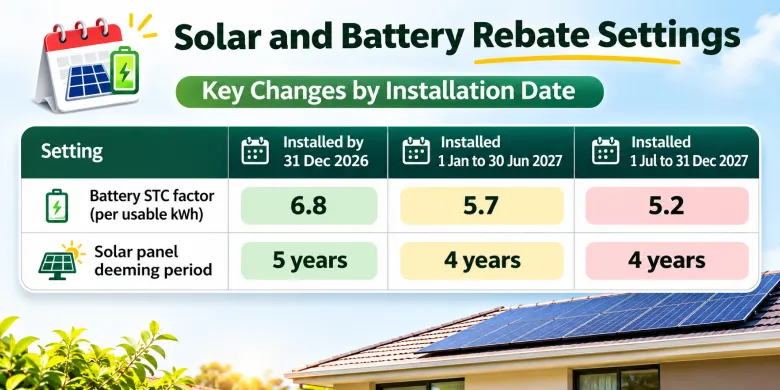
Quick answer: On 1 January 2027, the federal battery discount gets smaller because the STC factor falls from 6.8 to 5.7 certificates per kWh of usable capacity. The solar panel rebate also shrinks, as the deeming period drops from five years to four. Neither program ends. Both keep stepping down until 2030, and your installation date, not your contract date, sets the rate.
What changes on 1 January 2027
Both federal discounts are paid as small-scale technology certificates (STCs), which your installer takes off the price. Two settings that decide how many you get change on New Year's Day.
- Home batteries: the STC factor, which sets how many certificates a battery earns per kWh of usable capacity, drops from 6.8 to 5.7. It drops again to 5.2 on 1 July 2027, according to the Clean Energy Regulator.
- Solar panels: the deeming period falls from five years to four (Clean Energy Regulator deeming period table). The same 6.6kW solar system or 10kW solar system in the same postcode earns about one-fifth fewer STCs in 2027.
* This information is based on the Australian Government website and was accurate as of the date this blog was published. Please contact our solar experts for the latest updates.
What doesn't change
These federal battery rebate changes are a step-down, not an end date. The Clean Energy Regulator's schedule keeps the battery STC factor stepping down every six months until late 2030, and the solar deeming period reaches one year in 2030.
These rules stay the same in 2027:
- The tiers that started on 1 May 2026. The first 14 kWh of usable capacity earns the full STC factor. Every kWh from 14 to 28 kWh earns 60%, and every kWh from 28 to 50 kWh earns 15%.
- Battery eligibility. The Clean Energy Regulator requires a 5 to 100 kWh battery on the Clean Energy Council approved list, installed with new or existing solar, capable of joining a virtual power plant (VPP) and fitted by a Solar Accreditation Australia installer with battery endorsement. STCs are only paid on the first 50 kWh of usable capacity.
- One claim per home. Only one battery system per premises can claim STCs.
Is the home battery rebate being cut further?
Nothing beyond the published schedule has been announced. The government is looking for savings ahead of its mid-year budget update (MYEFO). On 7 November 2026, the ABC reported that the Prime Minister had not ruled out means-testing the battery subsidy. We will update this page if the rules change.
How to plan your install around the change
The Clean Energy Regulator says battery rebates are set by the installation date, not when a contract is signed (CER, March 2026). A contract signed in December for a January installation gets the 2027 rate. Before the May 2026 change, the Regulator also warned retailers not to rush installs or promise dates they could not meet.
Before you sign a quote:
- Get the installation date in writing, and ask who covers the difference if the job moves into January.
- Size the battery to your evening use, not to the deadline. An oversized battery can cost you more than the certificates you save.
- In NSW, compare VPP offers separately. The NSW VPP incentive is paid through VPP providers, is based on the battery capacity you make available to the grid (capped at 28 kWh) and can be claimed once per electricity meter.
Already have panels? The same battery rules apply when you add storage to an existing system, and our hybrid solar system page shows how panels and a battery work together.

Questions to ask your installer
- Which STC factor and deeming period does this quote use?
- What is the confirmed installation date, and who covers any price change if it slips?
- What is the battery's usable capacity, not just its total capacity?
- Is the battery on the Clean Energy Council approved list, and is the installer SAA-accredited with battery endorsement?
Key takeaways
- Battery STC factor: 6.8 now, 5.7 from 1 January 2027, 5.2 from 1 July 2027.
- Solar deeming period: five years now, four from 1 January 2027.
- Both programs run until 2030, and the installation date sets your rate.