
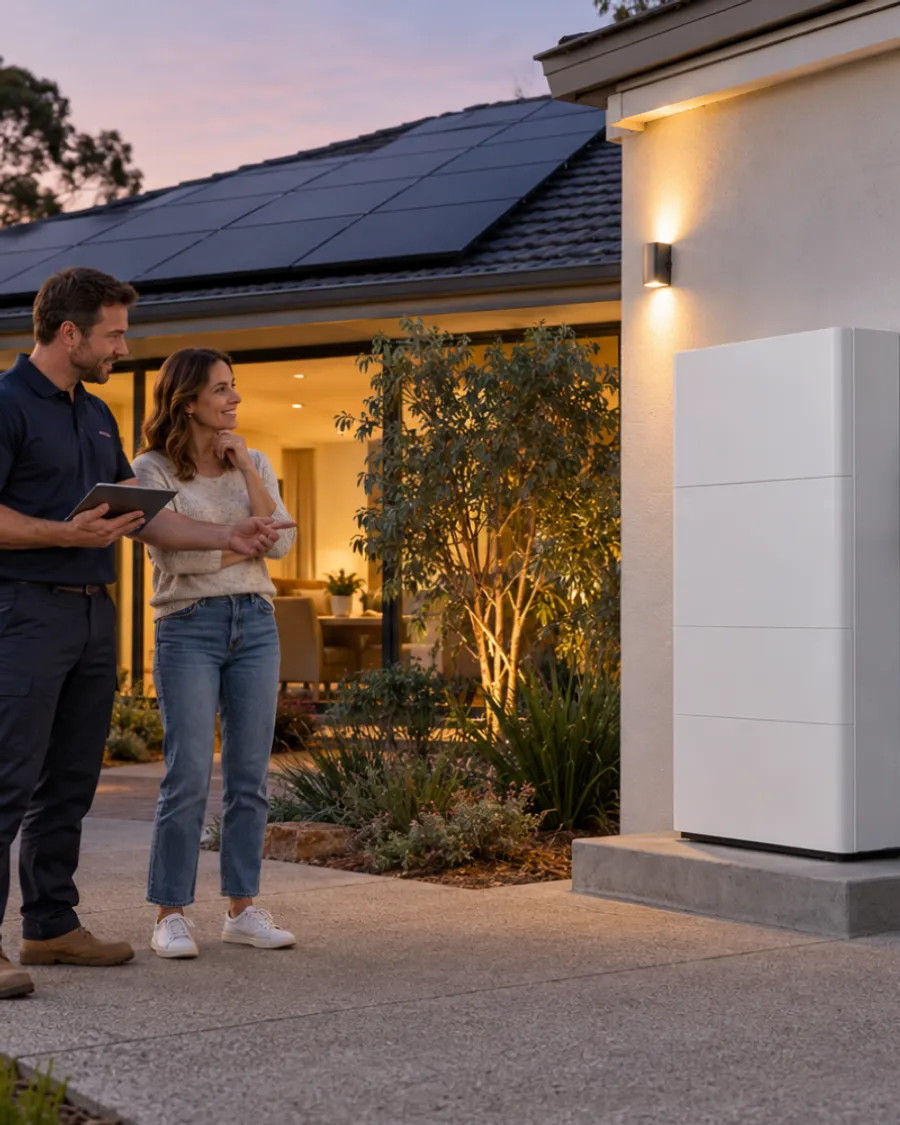
Solar Battery System: How to Judge One Before You Buy
A solar battery system stores the electricity your panels make during the day so you can use it after sunset instead of buying it from the grid. Whether that is worth doing depends on how you use power, what you expect from it in an outage, and which government rules apply to the battery you choose.
This page works through those decisions with Australian Government figures, for homeowners comparing a solar battery for home use. If you are still choosing panels, see our residential solar range or the hybrid solar system.

What a home solar battery system can do?
lists five ways a battery can reduce bills: raising self-consumption, using time-of-use tariffs, cutting peak demand, joining a virtual power plant (VPP) and reducing curtailment. Savings are largest when you are on a time-of-use plan and draw stored solar power during the expensive peak period.
A solar battery system tends to suit homes that use most of their power in the evening, and suits homes that already use their solar power as it is generated less well. Check your own pattern on your bill before comparing quotes.
The reasoning is simple. Feed-in tariffs are typically a lot lower than the rate you pay for grid electricity, so using your own solar power saves more than exporting it. A battery lowers what you are paid for exports, but generally by much less than it raises your savings.
How to read a battery spec sheet
| Term | What it tells you |
|---|---|
| Nominal capacity | Total kWh the battery holds. Household batteries typically run from 4 to 14kWh. |
| Usable capacity | What you can draw. For lithium-ion, it is only 5% to 10% below nominal. |
| Power output (kW) | How many appliances can run at the same time. |
| Cycles or throughput | Lifespan counted in charge-discharge cycles, or in total energy delivered. |
| Efficiency | A lithium-ion battery typically loses about 10% of the energy stored in it. |
Most household batteries are lithium-ion. There is no fixed battery size for a given array, so ask your installer which capacity figure a quote uses and how it was matched to your evening use. The same questions apply to any solar battery for home use, whatever the brand.
Adding a solar battery system to new or existing solar
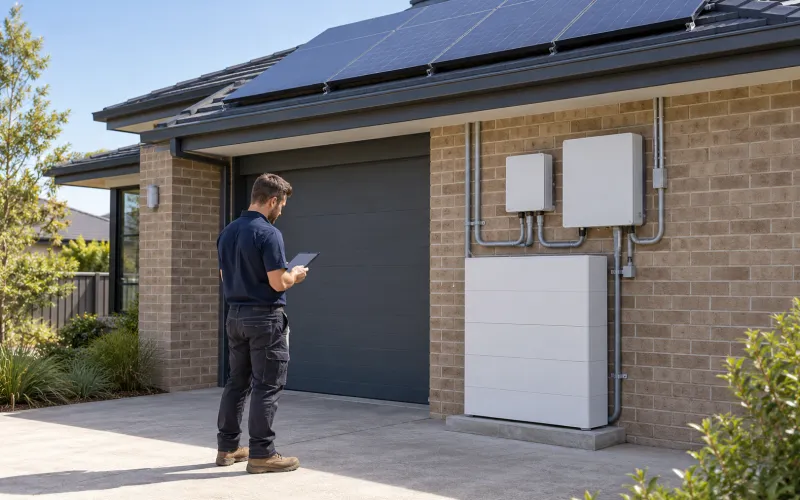
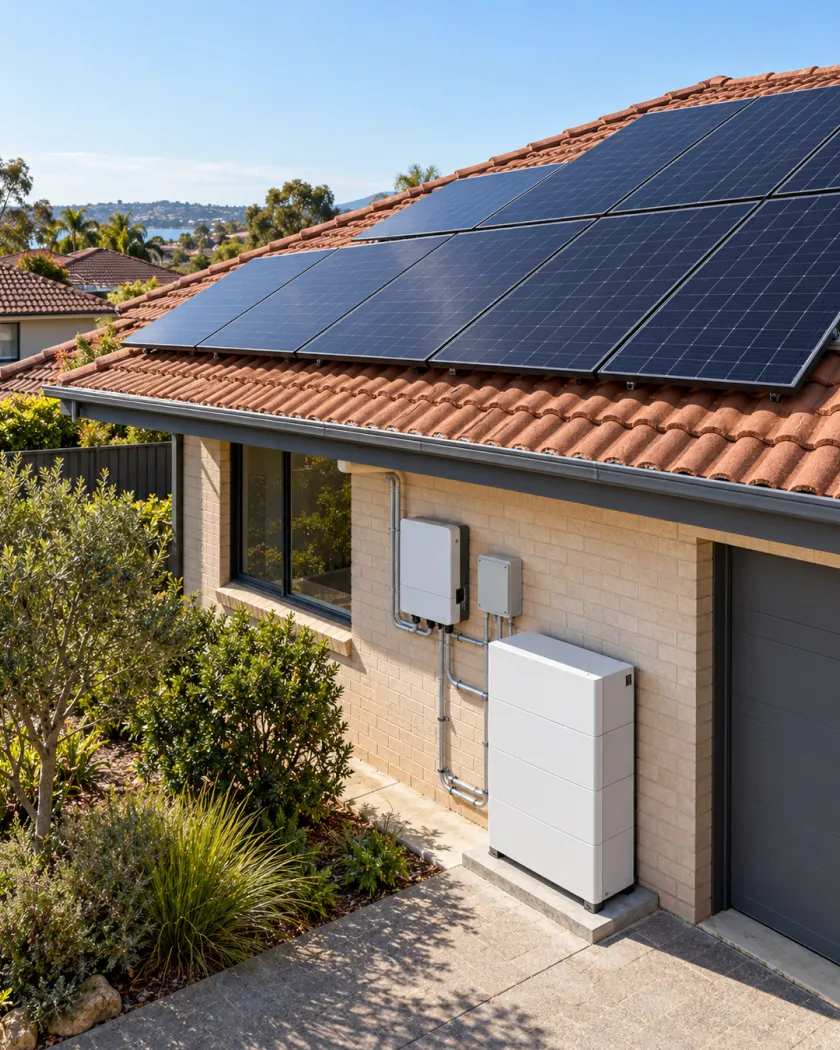
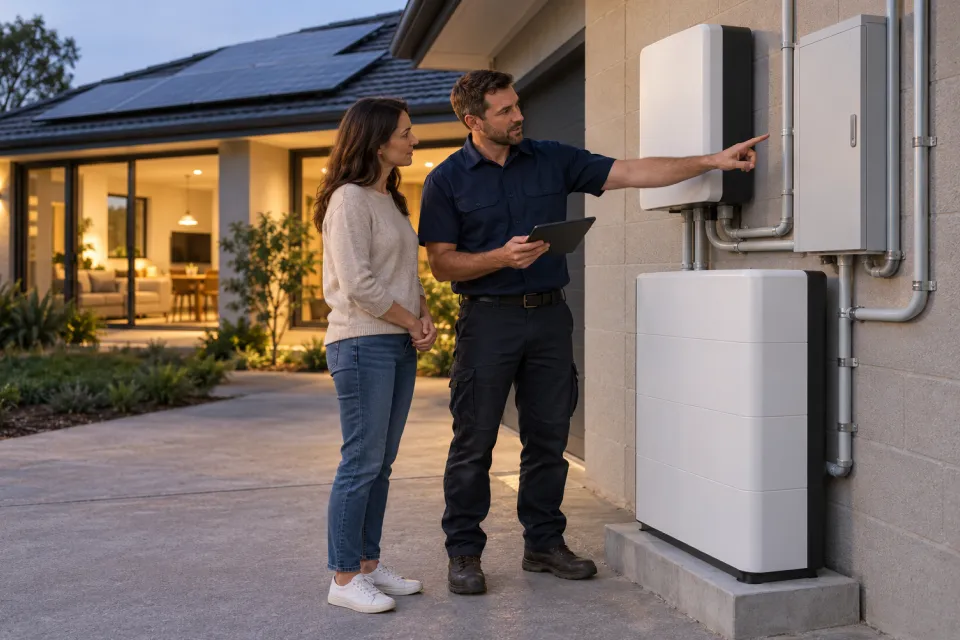
An AC-coupled battery uses a separate battery inverter. A DC-coupled system uses a hybrid inverter, and the panels charge the battery directly. AC coupling is the usual arrangement when you add a battery to existing solar. If you are building a new solar battery system, the same choice applies whether it is a 6.6kW solar system, a 10kW solar system or a 13kW solar system.
Backup power is a setting, not a default
A battery doesn't automatically keep the lights on in a blackout. In one setup, it supplies power until it is empty, then nothing until the grid returns. In a backup-capable setup, the home disconnects from the grid and keeps running, and solar recharges the battery when the sun is out.
The battery must be configured for this, and it may cover the whole property or only selected circuits. Tell your installer which appliances matter most in an outage, so the backup circuits are chosen to suit.
The Clean Energy Regulator's program page doesn't mention backup as a feature or a requirement, so get the circuits it covers in writing.
Warranty terms for a residential solar battery
-
many manufacturers offer a 10-year product warranty. One example performance guarantee is 60% of original capacity for 10 years.
-
Terms may run for a fixed number of years or a minimum number of cycles, whichever comes first, or be set as a throughput total in MWh. Read the conditions too, which can limit daily cycles, charging from the grid and exposure to weather.
Cheaper Home Batteries Program rules
The program delivers its discount on a home solar battery system through small-scale technology certificates (STCs). The Clean Energy Regulator puts the target at about 30% of upfront cost. The conditions that matter:
- Nominal capacity must be 5 to 100kWh, and only the first 50kWh counts. The factor is full to 14kWh, 60% from 14 to 28kWh and 15% from 28 to 50kWh.
- The STC factor is 6.8 per kWh for May to December 2026, down from 8.4 in January to April.
- It must be installed by a Solar Accreditation Australia installer with a battery endorsement.
- Only one battery per premises is eligible, installed with new or existing rooftop solar.
- It should stay at the property for the warranty period or until the end of 2030, whichever is later.
Rules like this change, so check the current program page before you buy.
Will a residential solar battery pay for itself?
A solar battery system will not pay back its upfront cost as fast as a solar-only system and may not pay itself off within its lifetime. In a worked example, break-even takes about 10.5 years, longer than a 10-year warranty.
A battery can still be worthwhile if you are buying it for backup in a power outage. Your own result depends on tariff, usage and incentives, so ask for any payback figure with its assumptions, and compare it with the warranty length rather than the sales pitch.
What NETCC requires of a solar battery system quote
Let's Be Green is an approved seller under the New Energy Tech Consumer Code (NETCC), For a solar battery system, it requires the seller to:

- Ask about your circumstances, needs and expectations, including energy for medical or life-support equipment.
- List the manufacturer, model, quantities and specifications, and state the system's limitations.
- Give a performance estimate that is reasonably based on reputable sources.
- State the product's expected life and disposal information.
- Show warranty details alongside Australian Consumer Law guarantees.
- Show the total price with rebates and discounts, valid for at least 10 business days.
- Back any return-on-investment figure with its assumptions, labelled as an estimate only.